
Key Takeaways
- Safety relays are crucial for monitoring safety inputs in industrial automation systems.
- Understanding the role of safety relays helps businesses choose the right Safety Relays Manufacturers in India.
- Effective safety relays can prevent accidents by ensuring machines respond appropriately to unsafe conditions.
- When selecting a safety relay, consider the specific safety functions your machine requires for optimal performance.
- Safety relays are crucial for monitoring and controlling safety functions in industrial automation systems.
Sanocs leading provider of industrial safety relay solutions for machine safety and automation applications.
As industrial automation becomes more advanced, machines depend on safety devices that can monitor critical signals and respond when unsafe conditions occur. Safety relays play an important role by connecting devices such as emergency stops, safety switches and other protective components with the machine control system. For businesses comparing Safety Relays Manufacturers in India, understanding how these devices work and where they fit into an automation system is essential before selecting a solution.
What Are Safety Relays?
Safety relays are dedicated control devices used to monitor safety-related inputs and control specific safety functions within industrial machinery.
Their role is different from that of a standard industrial relay. A standard relay primarily performs switching within a control circuit, while a safety relay is designed specifically for applications where the condition of a safety device must be monitored before machinery can continue operating.
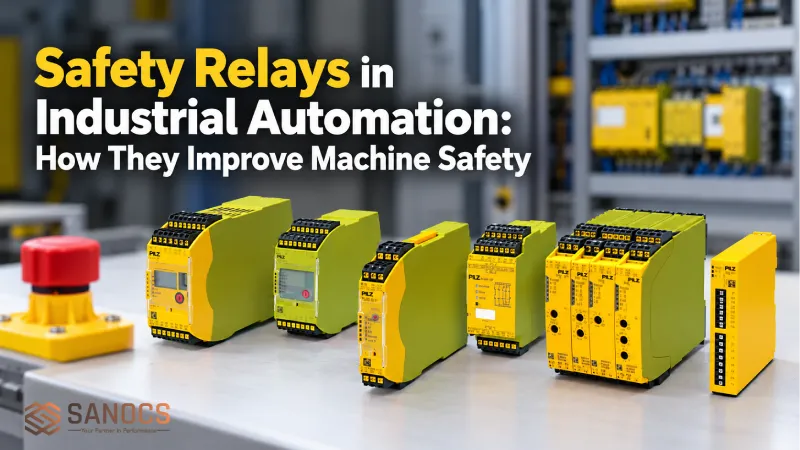
Pilz safety relays available through Sanocs include PNOZ safety relays designed for functional safety monitoring, along with the modular myPNOZ system.
How Safety Relays Work in Industrial Automation
A safety relay forms part of the connection between safety devices and the machine control system. The exact configuration depends on the machine and safety function.
A typical sequence works like this:
- A safety device, such as an emergency stop or safety switch, changes state.
- The safety relay receives and evaluates the relevant input signal.
- The relay processes the condition according to the designed safety circuit.
- The required output changes state to initiate the machine's specified safety response.
- Normal operation can resume only according to the designed reset and restart conditions.
The safety relay acts as a monitoring and decision component within the wider machine safety circuit.
This is why companies evaluating Safety Relays Manufacturers in India should consider the complete safety architecture rather than selecting a relay only by its electrical ratings.
Why Safety Relays Matter in Machine Safety
Automated machinery often includes moving parts, guarded areas, access doors and controlled operating zones. Safety devices positioned around these areas need an appropriate control component capable of evaluating their signals.
Safety relays can be used as part of systems involving:
- Emergency stop devices
- Safety switches
- Guard monitoring
- Safety sensors
- Light curtains
- Other machine safety inputs
The relay provides the link between these devices and the machine's safety-related control response.
For B2B buyers, this makes safety relay selection an important engineering decision rather than a routine control-panel purchase.
Pilz PNOZ Safety Relays
The Sanocs product page identifies Pilz PNOZ safety relays as solutions for dependable functional safety monitoring. Pilz also offers the modular myPNOZ system for machine and system safety applications.
PNOZ is part of the Pilz safety product portfolio and can support different machine safety requirements depending on the selected device and application.
The Sanocs page currently groups Pilz relay solutions into:
- Safety relay/safety relays PNOZ
- Monitoring relays
- Line monitoring devices
- Brake control devices
- PES – Logic board PNOZsigma
This broader range helps industrial buyers consider safety monitoring alongside electrical monitoring and other control requirements.
Safety Relays vs Standard Industrial Relays
Although both devices are described as relays, their intended roles within machinery are different.
| Selection Point | Safety Relay | Standard Industrial Relay |
|---|---|---|
| Primary purpose | Safety-related monitoring and control | General electrical switching |
| Typical application | Machine safety circuits | Automation and control circuits |
| Connected devices | Emergency stops, guards, safety sensors | General switches, PLC outputs, loads |
| System role | Evaluates safety conditions | Performs normal switching |
| Selection focus | Safety function and machine design | Electrical and switching requirements |
A standard industrial relay should therefore not automatically be treated as a substitute for a dedicated safety relay.
How Safety Relays Support Automated Machinery
Modern industrial automation combines production control with protective systems. The safety relay forms part of the protective side of this architecture.
When a machine includes automated movement, the safety system may need to monitor several conditions before permitting continued operation. Depending on the application, these conditions can come from access protection, emergency stop devices or safety switches.
A well-designed safety circuit coordinates these inputs so that the machine responds according to the intended safety function.
Businesses searching for Safety Relays Manufacturers in India should therefore first define what safety function needs to be monitored and how that function interacts with the machine control system.
What Are Monitoring Relays?
The Pilz relay range shown by Sanocs also includes PMD electronic monitoring relays. The product page describes these devices as supporting electrical safety supervision.
Monitoring relays and safety relays can therefore serve different purposes within industrial systems.
Safety relays focus on safety-related control functions, while monitoring relays can supervise defined electrical conditions. The appropriate product depends on what the machine or electrical installation needs to monitor.
This distinction is particularly useful for engineers specifying multiple relay functions inside industrial control panels.
What Should B2B Buyers Check Before Selecting a Safety Relay?
Safety relay selection should start with the machine's application rather than the product catalogue.
Before choosing a relay, buyers should verify:
- Which machine safety function needs to be monitored.
- Which devices will provide the safety inputs.
- How many safety inputs and outputs the application requires.
- What reset and restart behaviour is required.
- Whether the application needs a standalone relay or a modular safety solution.
- How the relay will integrate with the existing machine control architecture.
- Whether future machine modifications may require additional safety functions.
These checks give engineers and procurement teams a clearer specification when approaching Safety Relays Manufacturers in India.
Standalone Safety Relays and Modular Solutions
Not every automation system has the same complexity. Some machines may require a relatively straightforward safety function, while others may need several coordinated safety functions.
Pilz offers both PNOZ safety relays and the modular minor system according to the current Sanocs product page.
A standalone relay can be considered when the application involves clearly defined safety functions. A modular approach may be more appropriate when the machine requires a more flexible configuration.
The final decision should be based on the actual machine design, required safety functions and integration requirements.
Safety Relays as Part of a Complete Safety System
A safety relay should not be considered the entire machine safety system.
Industrial safety normally involves a combination of physical guarding, safety sensors, emergency stops, interlocks and safety-related control devices. Sanocs currently provides solutions across machine guarding, safety switches, safety relays, controllers, scanners and safety sensors.
The safety relay becomes most effective when it is correctly selected and integrated with these surrounding components as part of the overall machine design.
Why Choose Us
Sanocs supports industrial machine safety and automation applications with Pilz safety relay solutions, including PNOZ safety relays and related monitoring products. Our focus is on understanding the required machine safety function and helping B2B buyers identify an appropriate solution for their automation system. With experience across machine safety integration and access to multiple industrial safety technologies, we can support customers who need more than a standalone component and are evaluating a complete machine safety approach.
Conclusion
Safety relays play an important role in industrial automation by monitoring safety-related inputs and supporting the required machine response when a protective device changes state. The right relay depends on the machine, connected safety devices, control architecture and number of safety functions involved. Pilz offers PNOZ safety relays, modular myPNOZ solutions and related monitoring relay technologies for different industrial requirements. For companies evaluating Safety Relays Manufacturers in India, working with Sanocs can help simplify product selection and integration by focusing on the actual machine safety application rather than choosing a relay in isolation.
Looking for Pilz safety relays for your machine, control panel or industrial automation system? Contact Sanocs to discuss your application and identify the right safety relay solution for your machine safety requirements.
Call: +91 9879242755
Email: inquiry@sanocs.in