
Key Takeaways
- Understand the different types of safety switches available for various industrial applications.
- Safety switches protect operators by monitoring machine guards, gates, and access points.
- When selecting safety switches manufacturers in India, assess operating principles and compatibility requirements.
- Avoid common mistakes like overlooking protection ratings and actuator alignment during your safety switch selection process.
- Understand the role of industrial safety switches in monitoring machine guards and ensuring operator safety.
Sanocs leading provider of Industrial Safety Switches for machine guarding and industrial automation applications.
Industrial machines require reliable safety mechanisms to protect operators and control hazardous movements. Safety switches play an important role by monitoring machine guards, access doors, and protective covers. Businesses searching for Safety Switches Manufacturers or Safety Switches Manufacturers in India should understand the available switch types, operating principles, and compatibility requirements before selecting a suitable product.
What Are Industrial Safety Switches?
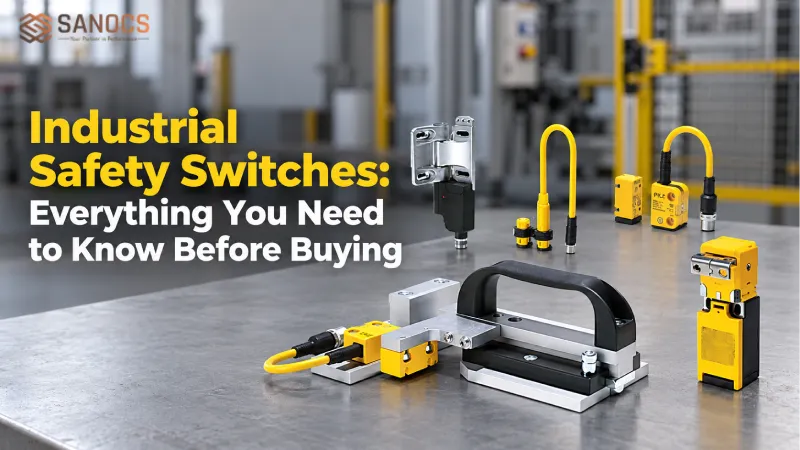
Industrial safety switches are protective devices designed to monitor the position or status of machine guards, safety gates, covers, and other movable protective components.
When a monitored guard opens, the switch communicates its status to the machine safety control system, which responds according to the designed safety function.
Unlike conventional switches used for routine machine operations, industrial safety switches are selected for safety-related applications.
Their primary purpose is to detect guard conditions and support the safe control of hazardous machine movements.
For manufacturing facilities operating automated equipment, selecting a suitable safety switch helps maintain effective machine guarding and controlled access to hazardous areas.
How Do Industrial Safety Switches Work?
The operation of a safety switch depends on its technology and integration with the machine's safety control system.
A typical guard-monitoring process follows these steps:
- Guard closed: The safety switch detects the designated closed position of the machine guard.
- Status monitoring: The switch communicates its condition to a compatible safety controller or evaluation unit.
- Guard opened: The switch detects a change in the guard's position or actuator state.
- Safety response: The control system initiates the required safety function, such as stopping hazardous movement.
- Restart conditions: The machine can resume operation only after all necessary safety requirements have been met and the correct restart steps have been completed.
The switch itself is only one component of the safety function. Its performance also depends on appropriate installation, wiring, monitoring, and machine control design.
Types of Industrial Safety Switches
Different industrial machines require different guard-monitoring technologies.
| Safety Switch Type | Operating Principle | Typical Application |
|---|---|---|
| Mechanical Safety Switch | Detects guard movement through mechanical actuation | Gates, covers, and access panels |
| Magnetic Safety Switch | Uses non-contact magnetic sensing | Protective doors and movable guards |
| Coded Safety Switch | Detects a matching coded actuator | Applications requiring greater resistance to manipulation |
| Uniquely Coded Safety Switch | Uses individually assigned actuator coding | Applications requiring high manipulation protection |
Each technology offers different installation and monitoring characteristics.
When comparing Safety Switches Manufacturers, buyers should identify the machine's guarding requirements before choosing a particular switch technology.
Key Features to Consider Before Buying
Industrial safety switches should be evaluated according to technical suitability rather than appearance alone.
Important features include:
- Guard monitoring: Detection of the open or closed condition of safety gates and protective covers.
- Compact construction: Suitable dimensions for installation in restricted machine spaces.
- Protection rating: Appropriate resistance to environmental conditions, including dust and moisture.
- Manipulation protection: Coded technology where additional protection against deliberate bypassing is required.
- Series connection: The device can be connected in series with other compatible components, provided the system supports this configuration.
- Controller integration: Ability to operate with the intended safety controller or evaluation unit.
The Pilz product range featured by Sanocs includes protection ratings such as IP65, IP67, and IP6K9K, depending on the switch series.
These ratings should always be checked against the exact product model and the environmental requirements of the application.
Why Is EN ISO 14119 Important?
EN ISO 14119 addresses interlocking devices associated with machine guards. It provides guidance concerning the selection and design of interlocking arrangements, including measures against defeating interlocking devices.
The Pilz safety switches listed on our website are described as meeting requirements associated with EN ISO 14119.
However, selecting a switch associated with this standard does not automatically make an entire machine compliant.
The complete guarding arrangement, safety circuit, installation, and validation must be considered together.
Industrial buyers researching Safety Switches Manufacturers in India should evaluate manufacturer documentation and the suitability of the device for the intended safety function.
Where Are Industrial Safety Switches Used?
Safety switches are used wherever machinery requires monitoring of access points or movable protective guards.
Some common applications include:
- Manufacturing machines: Monitoring access doors and protective panels.
- Packaging equipment: Detecting the position of movable machine covers.
- Automated production lines: Monitoring safety gates around moving equipment.
- Robotic workcells: Monitoring access gates around restricted operating areas.
- Material handling systems: Monitoring guarded access points around machinery.
- Processing equipment: Detecting access-cover conditions where safety monitoring is required.
The suitability of each switch depends on the hazards, machine operation, and protective design.
Experienced Safety Switches Manufacturers provide technical specifications that help buyers evaluate these requirements.
What Should Buyers Check Before Selecting Safety Switches?
Before purchasing industrial safety switches, procurement teams, machine builders, and plant engineers should confirm the application requirements.
Use this practical buying checklist:
- Identify the type of machine guard being monitored.
- Sensing method: Select the most appropriate sensing technology—mechanical, magnetic, or coded—based on the application’s specific requirements.
- Confirm whether guard locking is required in addition to guard monitoring.
- Check the required protection rating for the installation environment.
- Review actuator alignment and available mounting space.
- Confirm electrical compatibility with the safety controller.
- Check the product documentation, installation instructions, and applicable safety specifications.
- Review series-connection requirements if multiple switches will be connected.
These checks support more informed discussions with Safety Switches Manufacturers in India and help buyers avoid selecting incompatible components.
Why Safety Controller Compatibility Matters
Industrial safety switches operate as part of a wider machine safety system. Their output signals must be interpreted correctly by a compatible safety controller or evaluation unit.
The Pilz safety switches listed on our product page can be integrated with suitable Pilz evaluation units and safety controllers.
Some supported configurations also allow series connection, which can simplify wiring arrangements across multiple monitored guards.
However, the suitability of series connection depends on the specific product combination and required safety performance.
Buyers comparing Safety Switches Manufacturers should request relevant technical documentation before finalizing an integration design.
Common Mistakes to Avoid When Buying
Choosing an industrial safety switch without evaluating the complete application can result in installation difficulties or inadequate guard-monitoring performance.
Common selection mistakes include choosing an unsuitable protection rating, overlooking actuator alignment, ignoring controller compatibility, or selecting a monitoring-only switch when guard locking is required.
Another important consideration is the distinction between a safety switch and a conventional position switch. Devices used in safety-related control functions must be appropriate for the intended safety application.
For companies evaluating Safety Switches Manufacturers in India, accurate technical specifications and application requirements should guide every purchase decision.
Why Choose Us
At Sanocs, we focus on industrial machine safety solutions and provide Pilz safety switches for applications requiring dependable guard and position monitoring. Our product range includes mechanical, magnetic, and coded switch technologies, with options suitable for different machine layouts and operating environments. We understand that industrial buyers need more than a product description. Our approach emphasizes application suitability, technical compatibility, and clear product information to help customers identify safety switches that align with their machinery and operational requirements.
Conclusion
Industrial safety switches are important components of modern machine guarding systems. They monitor safety gates, protective covers, and access points while communicating guard conditions to safety-related control equipment. Selecting the right device requires careful consideration of operating principles, environmental protection, actuator coding, installation arrangements, and controller compatibility.
Businesses comparing Safety Switches Manufacturers and Safety Switches Manufacturers in India should prioritize technical suitability and the requirements of their specific machinery. With Pilz mechanical, magnetic, and coded safety switch options, Sanocs supports industrial buyers looking for practical machine safety solutions that fit their guarding and automation applications.
Looking for reliable Industrial Safety Switches for your manufacturing facility?
Contact our team to discuss your machine guarding requirements, explore Pilz safety switch options, and identify a suitable solution for your industrial application.
Call Now: +91 9879242755
Email: inquiry@sanocs.in
Send your industrial safety switch requirements today and connect with our team for product selection and purchase assistance.